Backpropagation by Hand
Task: before trusting a deep learning framework’s autograd, work through backpropagation by hand on a small, concrete network, to actually see how the gradient flows backward through each layer rather than taking it on faith. This came out of wanting a deeper understanding of how convolutional neural networks actually learn.
Approach: picked a small fully-connected network, a 4-element input, one 3-neuron hidden layer, a 2-element output, sigmoid activations throughout, with specific starting weights, biases, and a target output, then worked through the whole thing by hand: the forward pass (pre-activation and activation at each layer), the mean-squared-error loss, and then backpropagation itself, applying the chain rule layer by layer to get the gradient of the loss with respect to every weight and bias, finishing with the updated weights after one gradient-descent step.
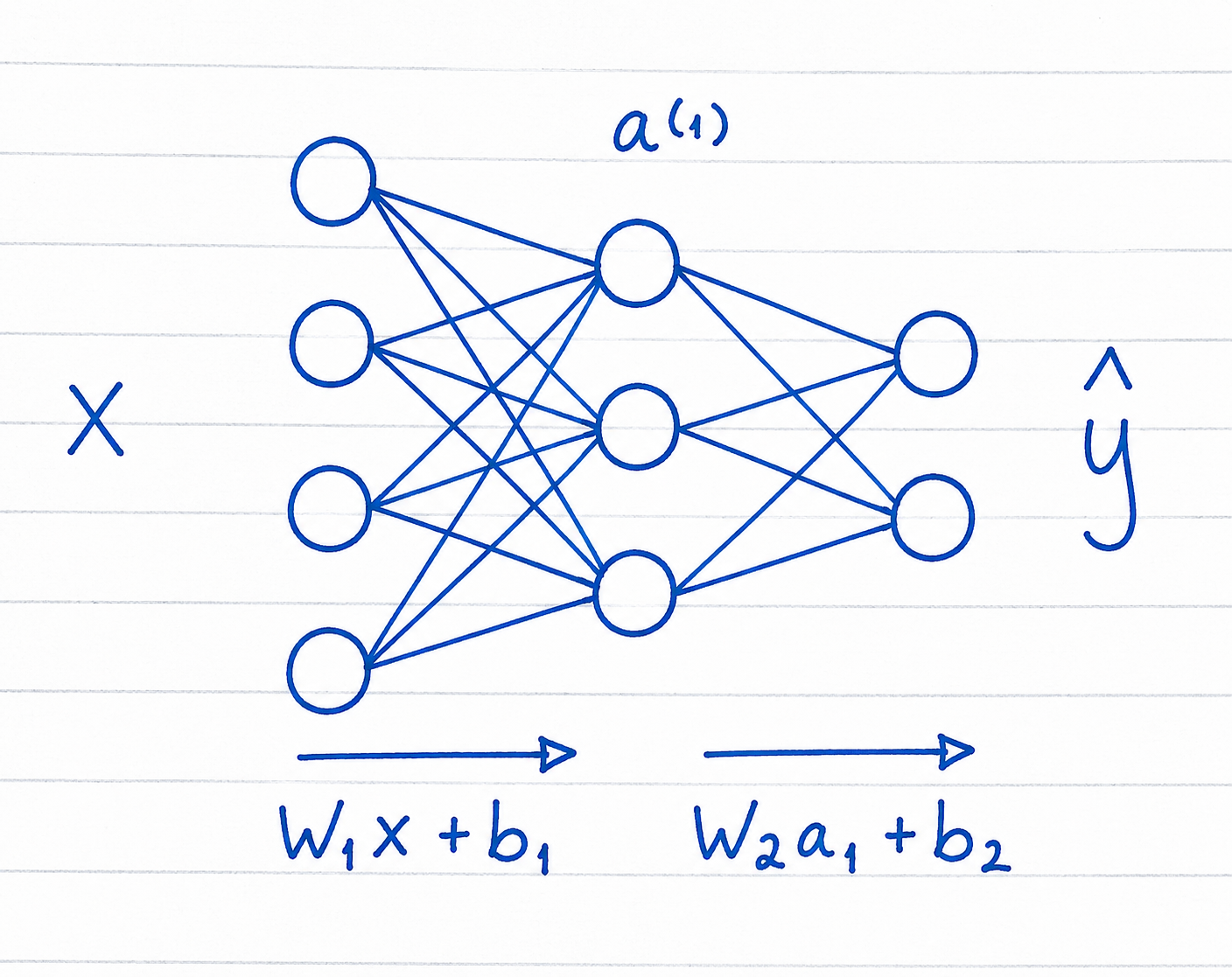
Outcome: a complete, numerically worked backpropagation example, from forward pass through to updated weights, that ties every term in the chain rule (the output error, the sigmoid derivative, the upstream weight matrix) to an actual number rather than an abstract symbol. That concrete grounding is what made the same mechanism click later when applied to a CNN’s convolutional layers.